
Mavic Wheels – How to identify a compatible replacement rim
Perhaps you have damaged your wheel rim due to hitting a pothole. Or perhaps if you are using rim brakes, the braking surface has worn out. In which case you may be considering whether you can replace the rim, and if so how to go about it.
This article will explore the things you need to think about, as well as provide some useful tips on how to identify a suitable rim. The article focuses on the mid and upper range wheels that have FORE drilled rims. These use proprietary spokes. Only Mavic supply suitable rims and spokes.
One caveat, this article explores the characteristics to consider when trying to identify a rim that will be compatible with your wheel. The article does not explore nor make any recommendations regarding whether a compatible rim will provide the same level of performance or strength as the original wheel.
Ok so first step is to identify which wheel you have and then goto the Mavic Technical Manual website to determine if there is a replacement rim available for your wheel, and if so what the part number is.
Refer to our guide Which Mavic Spoke do I need ? , the first part of which talks you through how to identify which Mavic wheel you have to obtain the correct Mavic Technical Manual page which shows an exploded diagram with all constituent parts identified.
Sometimes you may see that there is more than one replacement rim part number identified. This can typically occur when a later generation of the wheel is released, and its rim is compatible with the earlier generation. For example see below, where the 2021 Allroad S wheel can use rim part number V4092115 or V00097531 (with V4092115 being the original rim, and V00097531 being the rim used on the later generation 2023/24 Allroad S wheel). There may be some cosmetic differences (eg. In this case the branding is different ), but technically the rim will work fine.
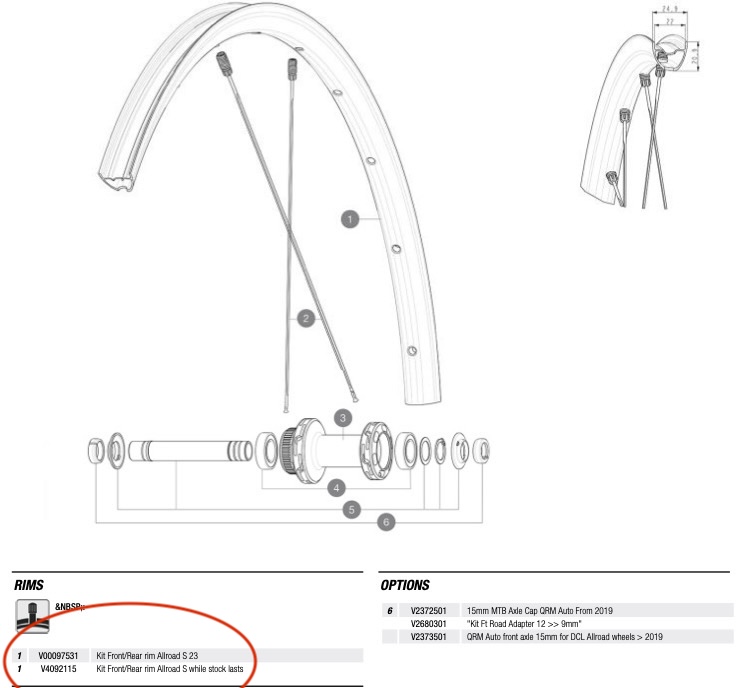
It’s also worth noting that on some wheels, the front and rear wheels use the same rim (as is the case with the Allroad S)
Ok so that is the easiest outcome, ie. You identify the rim you need using the Technical Mavic site, and you then order it from your favourite Mavic retailer, and once you have received it, crack on with the rebuild.
However what happens if you cannot identify or locate the rim using the Technical Manual ?. This can be the case if the wheel you have is perhaps more than five years old. Mavic have a policy whereby they will cease production of spare parts once the part has no longer been used in any wheel for 5 years. This can be very frustrating , particularly if your wheels are in great condition but have just suffered a dinged rim due to a pothole or perhaps braking surface wear.
In this scenario what is needed is to be able to determine if any rims that are still made by Mavic or still sold by retailers would be suitable and compatible for your wheel.
How to identify a compatible FORE drilled rim
Firstly determine whether you need a disc or rim brake rim !
Once that’s sorted :>) , then go on to consider the number of spoke drillings. Typically this will vary from 16 (for some older front wheels) to 24 (for many of the more recent Front and Rear wheels).
If UST Tubeless is important then this will also be a factor , as many earlier (pre 2019 ) wheels will not have UST rims.
If rim depth is an important factor for you (eg. You may want a shallow rim ) then this needs to be factored in.
Similarly the inner rim width will be an important consideration. Go back 15 years and most Mavic road rims had an internal width of 15mm (ie ETRTO 622x15C). This typically meant that 32mm was widest tyre that you could use. Nowadays of course rims are significantly wider. Road wheels are now typically 19mm internal, and gravel 22mm or more. If you are using your wheel on a close clearance classic rim brake frame, then the rim width will be an important consideration.
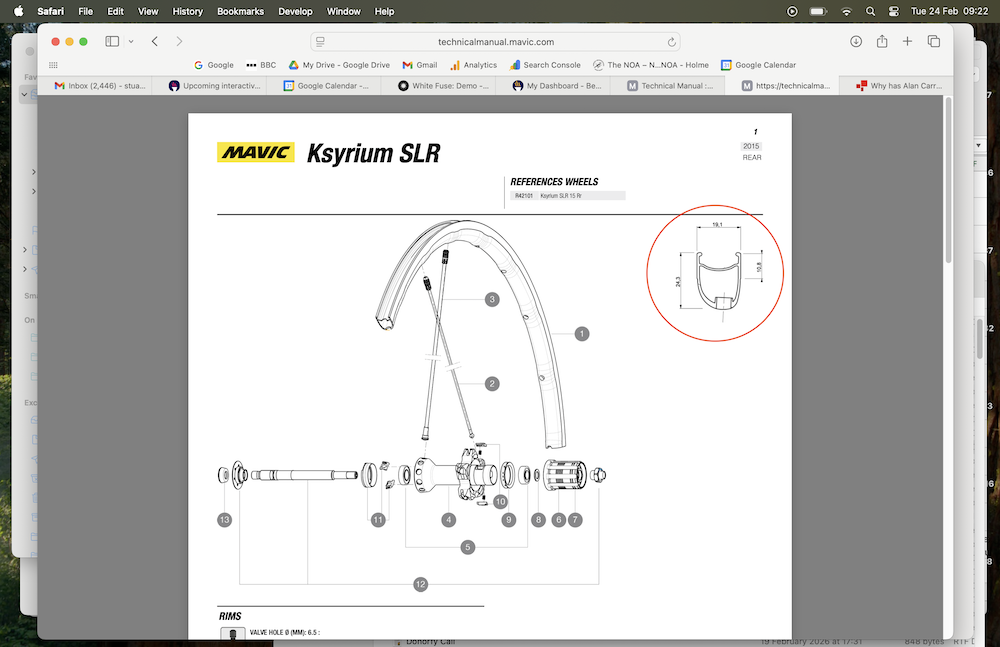
Another consideration is whether the existing rim has asymmetric spoke drillings. This feature was used on many of the higher end (eg. Ksyrium SLR ) wheels around the 2014-2017 era. If your existing wheel has this feature (example Tech Diagram below) then your replacement rim will need to have the same feature, otherwise you may find your existing spokes may not be a suitable length.
Then we get onto the most important factor – the Effective Rim Diameter. The ERD is critical in determining whether a rim will be a suitable replacement. Simply put the ERD is the measurement across the rim , typically measured across opposing spoke drillings – see below. Of course it’s this measurement , together with the hub flange diameter which will determine the length of spokes required.
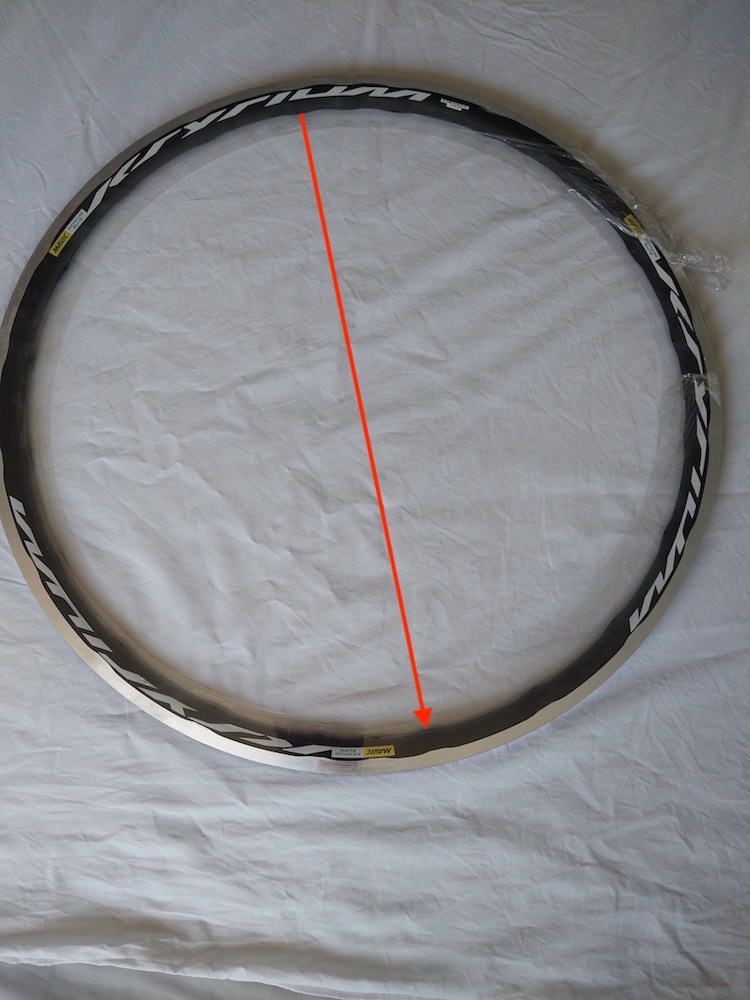
When looking to replace a rim, you do not want to have to change all your spokes (to do so, particularly for FORE drilled rims, will typically mean it may not be economically viable). If your hub is remaining the same then the rim ERD needs to be the same as or very close to your existing rim.
So how close ? Well from our experience of having supplied many replacement rims a replacement rim that has ERD of 2mm less or 1mm more is the rule of thumb to work with. If the ERD is 2mm less then the existing rim, this means that the existing spokes will be 1mm too long. FORE drilled spokes have somewhere between 7mm and 13mm of thread . As long as all spokes are equally threaded (ie. Screwed in to the same amount) into the rim during the rebuild , there should not be an issue with a spoke being 1mm too long.
Similarly if the replacement rim ERD is 1mm greater than the existing rim, this will mean that the spokes will be just 0.5mm short. Again provided that all the spokes are equally screwed into the thread during the rebuild, this will not be a problem. As an aside we regularly provided customers with alternative spokes that were 1mm shorter than the originals, with 100% success.
One big challenge in this space, is that Mavic do not publish the ERD of their wheel replacement rims. We have kept a record of ERD measurements of some of the rims we have supplied to customers, so if you have a query about a rim ERD drop us an email or better still post a query on the forum (so others may benefit)
Ok, so the only other factors worth thinking about are the rim material and design. Mavic’s mid-range and higher rims are typically made from Maxtal alloy, and the higher-end wheels will often include ISM4D inter-spoke milling. The existence of either of these characteristics are not especially relevant regarding the technical compatibility of a rim, but rather are more personal choices. Clearly if your setup is close to the recommended weight limit of the wheel specification, then you should really only be considering replacing the rim with an identical rim as per Mavic documentation.